How to Make Money with Webild in 2026?
How to Make Money with Webild in 2026
Let me tell you what changed my mind about AI website builders.
A couple of years ago, if you'd told me regular people — non-coders, non-designers, folks who can barely center a div — would be running profitable little website businesses from their laptops, I'd have smiled politely and changed the subject. The tools just weren't there yet. They spat out ugly, templated junk that screamed "I was made by a robot in 2019."
Then the new wave hit. And honestly, this surprised me: the gap between "amateur" and "agency-quality" basically collapsed. Tools like Webild now let you type a sentence and get a clean, modern, launch-ready website in minutes. Not a wireframe. A real site, with hosting and a domain attached.
That shift isn't just cool. It's a business opportunity — and most people are still sleeping on it.
So let's talk about how to make money with Webild in 2026. Not in a hand-wavy "passive income while you sleep" way, but with seven real, proven models that actual entrepreneurs are using right now. I'll be straight with you about what works, what takes effort, and where the money actually hides.
Grab a coffee. This is the good stuff.
What Is Webild?
Before we get into the money, let's make sure we're on the same page about the tool, because the whole strategy depends on understanding what it can do.
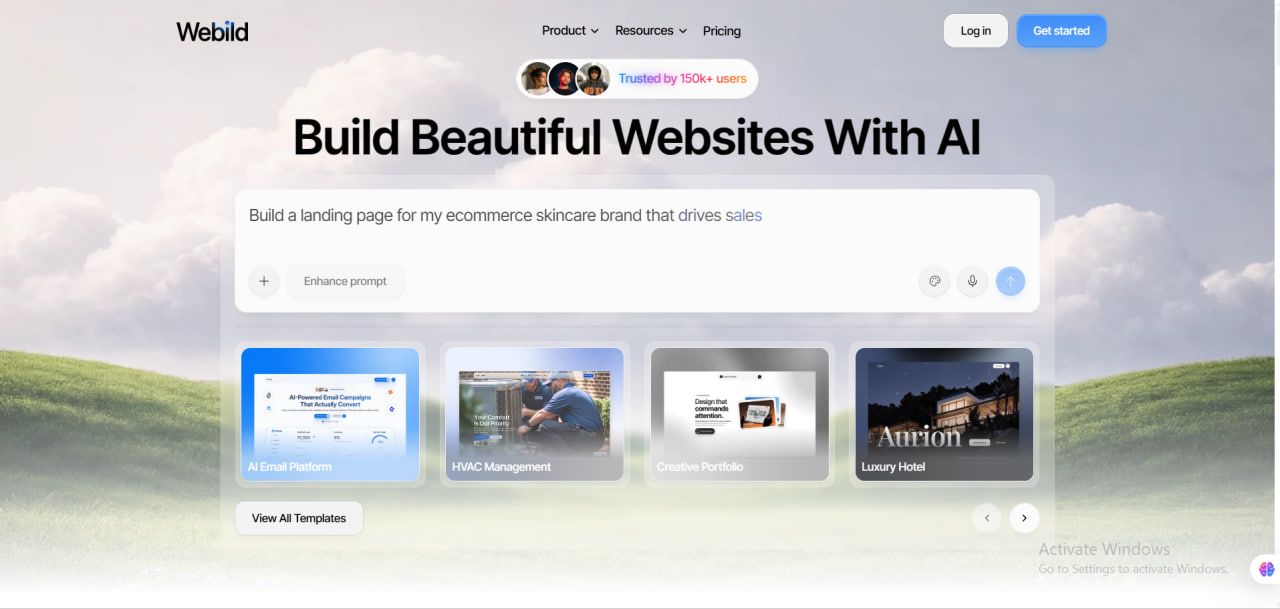
Webild is an AI-powered website builder. You describe what you want in plain English — "a modern website for a downtown Italian restaurant with an online menu and a reservations section" — and it generates a complete, functional site. Layout, copy, images, structure. The whole thing. There's even a built-in AI copilot (they call it Bob) that helps you tweak and refine as you go.
Here's what's actually under the hood, and why it matters for making money:
AI website generation. This is the headline feature. From a single prompt, you get a real site. The speed here is the entire business case — what used to take a freelancer days now takes you an afternoon.
Customization. You're not stuck with whatever the AI guesses. You can fine-tune everything through a visual editor or just by talking to the AI in natural language. That blend of speed plus control is the sweet spot.
Hosting. Secure hosting comes baked in. You're not wrestling with cPanel or some sketchy shared server. The site goes live, it stays live, and you don't think about it.
Domains. Custom domain support is built in, so client sites can live on their own professional web address instead of an ugly subdomain. Crucial when you're charging money.
Blogs. Blogging tools are included on the higher plans, which — and I'll keep saying this — is where the SEO traffic (and a lot of the money) actually comes from.
Analytics. You get traffic and visitor data so you can prove results to clients or track your own projects. "I grew your traffic 40%" is a sentence that renews contracts.
E-commerce. Payments and online store features are supported, so you can sell physical or digital products directly through the site.
One honest note: Webild is a newer, fast-moving platform (still in beta in places), and it runs on a credit-based pricing model — a free tier with limited credits, scaling up to paid plans in roughly the $25–30/month range for the Pro tier, with more credits and features as you go up. Prices and features shift, so check the current pricing before you build a business plan around a specific number. The interesting part is that even the paid plans cost less than a single hour of a freelance developer's time. That math is the whole opportunity.
Why AI Website Builders Are Creating New Opportunities
Here's the thing nobody fully appreciates yet.
For two decades, building websites was gatekept by skill. You either learned to code, learned a clunky builder, or paid someone a small fortune. That barrier kept a lot of smart, hustle-minded people out of the website game entirely.
AI website builders nuked that barrier.
Today, a non-technical person can produce a professional site faster than a trained developer could have three years ago. Read that again, because it's wild. The bottleneck is no longer "can you build it?" The bottleneck is now "do you know who needs it and how to sell it?" — and those are business skills, not technical ones. Skills you can learn.
This is exactly why ai web design has become such fertile ground for solo entrepreneurs. The tool does the heavy lifting. You bring the hustle, the taste, and the customer relationships. Webild handles the part that used to require a computer science degree.
If I were starting from scratch today with zero coding ability and a few hundred bucks, I genuinely believe an AI website builder would be the fastest, lowest-risk way to start making money online. Let me show you the seven ways.
1. Sell Websites to Local Businesses
This is the classic, and it's classic because it works.
Walk down any main street in America and you'll find businesses with websites that look like they were built during the Obama administration. Dentists. Restaurants. Gyms. Real estate agents. Law firms. Half of them have sites that are slow, ugly, broken on mobile, or — believe it or not — nonexistent.
These people have money. What they don't have is time or technical skill. That's your opening.
The play is simple: build clean, modern sites with Webild and sell them to local businesses. Because the tool does the generation for you, you can turn a project around in a day or two instead of weeks. And here's the beautiful part — Webild has a Transfer Ownership feature on its higher plans, which means you can build the site and then hand the keys to the client cleanly. That's a genuine advantage when you're selling to clients who want to actually own their website.
Pricing? A basic local business site realistically goes for $300 to $800. A more involved build — multiple pages, e-commerce, custom touches, a booking system — comfortably hits $1,000 to $2,000+. Land a few of those a month and you've got a real income.
The mistake beginners make is thinking they have to be the cheapest. You don't. You're not selling a website. You're selling the outcome: more customers, more credibility, more bookings. A dentist who gets two new patients a month from a new site just paid for it ten times over. Sell that, not the pixels.
Most people completely overlook this opportunity because they assume "everyone already has a website." Go actually look. They don't. And the ones who do mostly hate theirs.
2. Start a Freelance Website Agency
Selling one-off websites is good. Building a website agency business is better, because it turns a hustle into something that compounds.
Here's the upgrade. Instead of just charging once and disappearing, you productize. Create clear packages — say, a Starter site, a Business site, and a Premium e-commerce site — at fixed prices. Clients love knowing exactly what they're getting and what it costs. You love not negotiating from scratch every time.
Then comes the move that changes everything: monthly maintenance plans.
Charge clients a recurring fee — $50 to $200+ a month — to keep their site updated, add new content, monitor analytics, swap seasonal promotions, and just generally "keep the lights on." Most clients happily pay it because they don't want to touch the site themselves, and with Webild's editing tools, these updates take you minutes.
This is where things start getting profitable. Ten maintenance clients at $100/month is $1,000 in recurring revenue before you've sold a single new project. Thirty clients is a full-time income that shows up whether you hustle that month or not. That recurring layer is the difference between a freelancer who's always chasing the next gig and an agency owner with predictable cash flow.
Start solo. As demand grows, you can bring on a contractor to handle builds while you focus on sales. That's a real business.
3. Build Affiliate Websites
Now let's talk about the more passive end of the spectrum, because not everyone wants to deal with clients. (No shame. Clients are a lot.)
Affiliate websites are content sites that earn commissions by recommending products. You write helpful articles, people click your links, they buy, you get paid. The website itself is the salesperson, working 24/7.
The categories that print money right now: product reviews, software reviews, and — extremely on-trend — AI tools blogs. Seriously, "best AI tool for X" content is exploding because everyone's hunting for the right software and the affiliate commissions on SaaS are juicy (often recurring).
Webild is genuinely well-suited for this because of its built-in blogging tools. You spin up a clean niche site, start publishing keyword-targeted articles, and let SEO traffic build over time. Someone searches "best AI website builder for restaurants," lands on your review, clicks your affiliate link, and you earn.
Now, real talk: this is not overnight money. Affiliate sites are a slow build. You're planting a tree, not microwaving a burrito. It can take months of consistent content before the traffic — and the commissions — really kick in. But once a piece of content ranks, it can earn for years with minimal upkeep. That's the dream of make money online for a reason.
The winners here are patient and consistent. The losers quit at month two. Choose which one you'll be before you start.
4. Create Lead Generation Websites
This one is my favorite, and most people have never even heard of it. So lean in.
Local service businesses — roofers, HVAC techs, plumbers, landscapers — live and die by leads. A single roofing job can be worth thousands of dollars to the contractor. That means a single qualified lead is worth real money to them. Some of these businesses will happily pay $20, $50, even $100+ per lead.
So here's the model: you build a sharp, local, SEO-optimized website targeting something like "emergency plumber [your city]." You rank it. It starts generating phone calls and form submissions from people who need that service right now. Then you sell those leads — or rent the entire site — to a local business owner.
You're not building a site for a client. You're building an asset that produces customers, and selling the customers.
The reason this is so powerful: you own the website. If a contractor stops paying, you call the next one in town, and trust me, they'll pick up. One ranked lead-gen site in a decent niche can quietly pay you every single month for years.
Webild makes the build fast and the hosting painless, so you can spin up and test multiple local niches without a huge upfront cost. The skill you're really developing here is local SEO, and that skill is gold. This is genuinely one of the most overlooked make-money models in the entire online business world, and the AI builder boom made it easier than ever to execute.
5. Launch a Personal Brand
Not every money path runs through other people's businesses. Sometimes the best business is you.
A personal brand is a long game with an enormous payoff, and a website is its home base. With Webild, you can stand up a polished personal site — blog, about page, the works — in an afternoon, then build outward from there.
The monetization stack on a personal brand is deep. You blog to build an audience and SEO traffic. You add a newsletter to own that audience directly (email is still king — algorithms can't take your subscriber list away). From there you layer in consulting or coaching, where people pay for your expertise one-on-one. And eventually you sell digital products to the audience you've built.
The beauty is that each piece feeds the others. The blog grows the newsletter, the newsletter sells the consulting, the consulting reveals what products to create. It's a flywheel.
This path takes longer to monetize than selling websites to local businesses, but the ceiling is dramatically higher — and nobody can fire you from your own brand. If you've got knowledge, a point of view, or even just a willingness to document your journey publicly, this is a phenomenal long-term bet.
6. Sell Digital Products
If you want margins that make a CFO weep with joy, sell digital products. You make them once and sell them infinitely. No inventory, no shipping, no restocking.
Webild's e-commerce features mean you can set up a storefront and start selling directly. What should you sell? A few that work beautifully:
- Templates. Website templates, Notion templates, resume templates, social media templates. People pay to skip the blank page.
- Ebooks. Package your knowledge into a tidy PDF and sell it. A focused, genuinely useful ebook on a specific problem sells surprisingly well.
- Courses. Teach a skill you have. Online courses can command premium prices because people pay for transformation, not information.
- Prompt collections. Very 2026, this one. Curated, tested AI prompt packs for specific jobs (marketing, writing, design) are a hot, low-effort product right now.
The honest catch: the product has to actually be good, and you still have to market it. "Build it and they will come" is a movie line, not a business plan. But once you've created something valuable and figured out how to drive traffic to it — through your blog, your social media, your newsletter — digital products become some of the closest thing to true passive income that exists.
Pair this with the personal brand from #5 and you've got a genuinely powerful one-two punch.
7. Build and Flip Websites
Last one, and it's for the entrepreneurs who think in assets.
Websites are buyable, sellable property. People purchase profitable or promising websites the same way they buy rental houses — for the income they produce. And sites typically sell for a multiple of their monthly profit (often somewhere in the range of 20–40x monthly earnings, depending on the niche and stability).
The model: build a niche website with Webild, grow its traffic and revenue (affiliate income, ads, lead gen, whatever fits), let it season for several months to a year, then sell it on a marketplace for a lump sum.
Think about the math. A little affiliate site earning $300/month might sell for $7,000–$10,000+. Build a few of those a year, flip them, and you've created chunks of capital you can reinvest or pocket.
This is more advanced — it rewards people who understand traffic, monetization, and patience. But it's a legitimate, proven path, and the low build cost of an AI website builder means your downside on each experiment is small while your upside is real. You're essentially doing real estate development, but for digital property, with a fraction of the risk.
Common Mistakes Beginners Make
Alright, let me save you some pain. I've watched a lot of people start these journeys, and the ones who fail almost always trip over the same few rocks.
Chasing too many ideas at once. This is the big one. You read an article like this, get fired up, and try to do all seven models simultaneously. Don't. Pick ONE. Get it working. Make your first dollar. Then expand. Scattered energy is the number one killer of new online businesses, and it's so seductive because every model looks shiny.
Ignoring SEO. A beautiful website with no traffic is a billboard in the desert. Whether you're doing affiliate, lead gen, or client work, understanding the basics of how people find sites on Google is non-negotiable. The AI builds the site; it can't make people visit. That part's on you.
Poor niche selection. Going too broad ("I'll build any website for anyone!") or picking a niche with no money in it will stall you out. Narrow and profitable beats broad and generic every time. A "websites for dentists in Phoenix" focus will outperform "websites for everyone" by a mile.
Lack of consistency. This is the quiet killer. Most of these models reward showing up repeatedly — publishing the content, sending the cold emails, building the next site. The people who win aren't the most talented. They're the ones who didn't quit in month two when it was still quiet. Boring consistency beats brilliant bursts.
Avoid these four, and you're already ahead of most beginners.
Final Thoughts
Here's what I want you to take away from this whole thing.
The tools have never been better, the barrier to entry has never been lower, and the opportunities have never been more accessible. A platform like Webild hands you capabilities that, not long ago, required a team and a budget. That's not hype. That's just where we are in 2026.
But — and this matters — the tool is not the business. Webild can generate a stunning website in two minutes. It cannot find your customers, write your cold emails, or make you stick with it for ninety days. That part is human. That part is you.
So if you're feeling that spark of "maybe I could actually do this" — good. Hold onto it. Then do the unsexy thing: pick one model from this list. Just one. The one that fits your situation, your skills, and your stomach for risk. Spend a weekend learning the tool. Build one thing. Sell one thing, or publish one thing. Make your first real dollar online.
Because that first dollar changes you. It turns "making money online" from a fantasy into a fact, and once it's a fact, everything after it is just scaling.
The website builder of 2026 is ready. The opportunities are sitting right there, mostly ignored by people waiting for a "perfect time" that never comes. If I were starting from scratch today, I wouldn't wait. I'd open Webild, pick a lane, and start building tonight.
Your move.
Quick honest disclaimer: the income ranges in this article are realistic possibilities, not guarantees. Results depend on your effort, niche, and consistency, and tool pricing and features change over time — always check Webild's current plans before building your strategy around them.
Comments
Log in to leave a comment.
No comments yet — be the first to share your thoughts.